

Why Perfume Cap Quality Matters
Learn how to evaluate perfume cap quality through material selection, closure fit, molding precision, coating durability, inner structure and retention performance. Practical insights from 山东爱丽化妆品.
A perfume cap may appear to be a simple decorative component, but it has an important role in packaging quality. Consumers handle it every time they open or close a perfume bottle. Its weight, surface texture, closing sound and fit all contribute to the perceived value of the product.
A poorly manufactured perfume cap can feel loose, scratch easily, lose its coating or fail to stay securely attached. Even when the fragrance and glass bottle are well made, these defects can make the finished product look less refined.
在 Shandong Aili Cosmetics Co.,Ltd., we view the perfume cap as part of an integrated packaging system. Its quality should be evaluated not only by appearance, but also by material properties, closure performance, manufacturing precision and compatibility with the bottle and spray pump.

1. Material Selection, Density and Weight
The material determines a perfume cap’s weight, strength, surface finish and manufacturing possibilities. Common options include zinc alloy, ABS, PP, Surlyn and natural wood.
| Material | Physical characteristics | Common applications |
| Zinc alloy (Zamak) | Relatively high density, solid feel, suitable for detailed casting and metal finishes | Premium and luxury-style perfume caps |
| ABS | Rigid, easy to mold and suitable for decorative coatings | Standard and customized perfume caps |
| PP | Lightweight, flexible and widely used in packaging components | Functional inner structures and economical caps |
| Surlyn | High transparency, glossy appearance and good impact resistance | Crystal-like decorative perfume caps |
| Natural wood | Visible grain, warm tactile feel and natural variation | Niche fragrance and distinctive packaging designs |
A heavier cap can create a more substantial impression, but weight alone does not prove quality. Some plastic caps use an internal metal weight to improve balance without making the entire cap from metal.
For buyers, the important considerations are material consistency, dimensional accuracy, structural strength and suitability for the product’s target price. A lightweight PP cap can be a good choice for a travel fragrance, while a zinc alloy cap may better suit a premium gift set.
2. Closure Mechanism and Opening Experience
The way a perfume cap attaches to the bottle determines whether it feels secure and comfortable during everyday use.
Three common closure designs are:
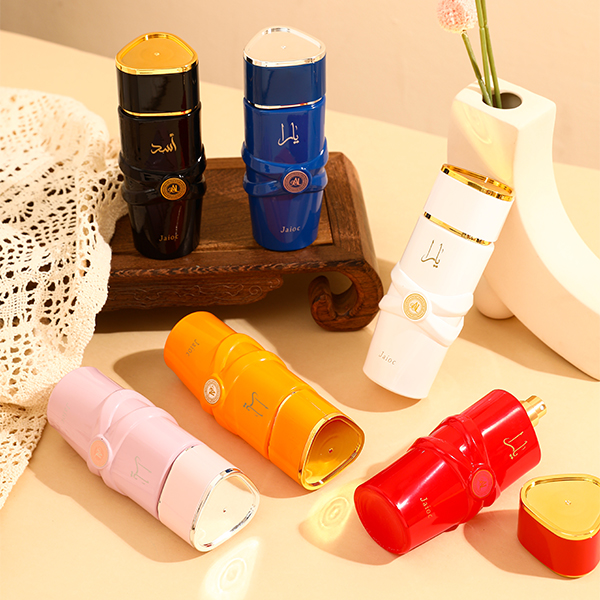
Magnetic closure: Small magnets are integrated into the cap or corresponding bottle components. When correctly aligned, the cap attaches with a controlled magnetic pull. Some designs also use mechanical positioning features to help align the logo or decorative details.
Click-fit closure: An internal insert or locking structure engages with the corresponding component. A clear clicking sensation can indicate engagement, although excessive force or a loud sound does not necessarily mean better quality.
Friction-fit closure: The cap is held in position through controlled contact between the inner cap and the pump collar or bottle assembly. It should remain secure without requiring excessive force to remove.
A good closure should provide a consistent opening and closing experience. Buyers should check whether the cap wobbles, slips off too easily or requires excessive pulling force. The cap should also remain compatible with the actual spray pump and collar dimensions.
3. Molding Precision and Surface Defects
Molding precision affects both appearance and assembly. Injection-molded plastic caps and die-cast metal caps have different manufacturing characteristics, but both should meet agreed dimensional and visual standards.
Inspect the following areas:
Mold seams: Parting lines should be controlled and should not have sharp edges or excessive flash.
Sink marks: Visible depressions caused by uneven material shrinkage should be limited.
Ejector marks: Marks on exposed surfaces should not affect the intended appearance.
Edge alignment: The top, sides and lower rim should be even and properly finished.
Logo detail: Embossed, engraved or printed logos should have clear outlines and consistent positioning.
A completely invisible mold line is not always technically realistic. What matters is whether the seam is properly located, smooth and acceptable under the agreed inspection standard.
For custom perfume packaging, buyers should approve a physical sample before mass production. A logo that looks sharp in a digital rendering may appear shallow, uneven or poorly positioned on the actual cap.
4. Surface Finishing and Coating Durability
Perfume caps are frequently touched by consumers. Skin oils, sweat, friction and accidental contact with perfume or cleaning products can gradually affect the surface.
Common finishes include electroplating, spray coating, anodized aluminum components, matte finishes, metallic effects and polished surfaces.
A reliable finish should have:
Consistent color and gloss across the cap
No obvious bubbles, peeling, scratches or uneven patches
Good adhesion to the underlying material
Resistance to normal handling and appropriate cleaning conditions
Coating durability should be tested according to the actual material and finishing process. For example, a coating designed for plastic may require different adhesion testing from an anodized aluminum component.
Alcohol-rub testing can be useful when appropriate, but it should not be applied indiscriminately to every finish. The test liquid, rubbing force, number of cycles and acceptance criteria should be agreed in advance.

5. Inner Structure and Chemical Compatibility
The inside of a perfume cap is often less visible than its exterior, but it can affect fit, durability and long-term appearance.
Many designs use a decorative outer shell combined with an internal insert. The outer component may be made from metal, wood or transparent resin, while the inner structure commonly uses engineering or packaging plastics such as PP or POM.
The inner cap should fit the spray pump or collar securely without cracking, excessive deformation or unwanted movement.
Chemical compatibility also deserves attention. Perfume contains ethanol and fragrance materials, and the cap may be exposed to vapor or occasional liquid contact around the nozzle. Materials should be selected to minimize swelling, odor transfer, discoloration and deterioration under intended storage and use conditions.
For this reason, we recommend evaluating the actual assembled packaging rather than selecting a cap based only on its material name.
6. Retention Strength and Assembly Reliability
A perfume cap should stay attached during normal handling, storage and transportation, while remaining easy enough for consumers to remove.
Retention strength depends on the closure design. Magnetic caps are evaluated by their magnetic holding force and positioning stability. Friction-fit and click-fit caps require suitable pull-off force and consistent engagement.
A practical inspection program can include:
Measuring cap removal force using an appropriate force gauge.
Repeating opening and closing cycles to check for wear or loosening.
Checking whether the cap remains attached during normal handling.
Inspecting the assembled bottle after suitable vibration or transport-simulation testing.
Some brands may require a stronger retention design, while others prioritize easy opening. The correct specification should reflect the bottle weight, cap structure, closure type and intended user experience.
Simply lifting a full perfume bottle by its cap is not a universal quality test. It may be used as a supplementary demonstration only when the closure has been specifically designed and approved for that load.
A Practical Four-Step Perfume Cap Inspection
For initial sample evaluation, buyers can follow four simple steps:
Feel the material: Check weight distribution, surface temperature, texture and structural solidity.
Test the closure: Open and close the cap several times to assess magnetic attraction, clicking engagement or friction resistance.
Inspect the finish: Look for mold seams, scratches, coating defects, uneven edges and poorly formed logos.
Check the assembly: Confirm that the cap fits the actual bottle and pump collar without wobbling, excessive force or accidental detachment.
For mass production, these observations should be supported by dimensional inspection, retention testing, coating evaluation and sample approval.
常见问题解答
- Does a heavier perfume cap always indicate better quality?
No. Weight contributes to tactile perception, but structural strength, fit, finish and material consistency are more important indicators of overall quality.
- Which material is best for premium perfume caps?
Zinc alloy, Surlyn, ABS and natural wood can all be used in premium packaging. The best choice depends on the desired appearance, weight, cost and product positioning.
- Are magnetic perfume caps better than friction-fit caps?
Not automatically. Magnetic caps provide a distinctive closing experience, while friction-fit caps can offer reliable and practical closure at a different cost level.
- How can buyers test perfume cap retention strength?
Use an appropriate force gauge to measure removal force and repeat the test across multiple samples. The required force should be specified according to the closure design.
- Why does a perfume cap become loose after repeated use?
Possible causes include wear of the inner insert, dimensional variation, material deformation or an unsuitable fit between the cap and pump collar.
- How can buyers evaluate perfume cap coating quality?
Inspect color uniformity, adhesion, scratches and resistance to appropriate handling and cleaning tests. Testing conditions should match the actual coating system.
- Is a double-shell perfume cap better than a single-piece cap?
Not necessarily. A double-shell design allows the exterior material and internal fitting structure to serve different purposes, but a well-designed single-piece cap can also perform reliably.
- Should perfume caps be tested together with the bottle and spray pump?
Yes. The cap, collar, pump and bottle form one assembled packaging system. Testing them together helps identify fit, retention and handling problems before mass production.

结论
A high-quality perfume cap is defined by more than its material or weight. It should have suitable structural strength, precise dimensions, a reliable closure mechanism, durable surface finishing and a secure fit with the complete perfume bottle assembly.
在 山东爱丽化妆品, we believe packaging quality comes from the coordination of every component. By evaluating perfume caps alongside glass bottles, spray pumps and fragrance formulas, we help OEM/ODM perfume fragrance buyers make more practical packaging decisions and reduce avoidable quality risks.